


To choose enter le passé composé and l'imparfait. You think you understand the difference between the two.
It depends on the type of action you want to express.
- The passé composé is used for actions courteous, precise, and thorough.
- Theimparfait means to talk about context, habits, or descriptions in the past.
A good image to understand: imagine a Movie scene. The setting and atmosphere are in the imperfect tense, the main actions are in the passé composé.
To differentiate between The passé composé and the imparfait is not always easy. These two tenses talk about the past, but they are not used in the same situations.
The passé composé is used to tell specific and completed actions, while the imparfait describes the context, habits, or emotions. But when speaking, it is often difficult to choose the right tense.
In this article, you will see how to choose between the passé composé and the imparfait, thanks to clear examples, a simple explanation, and a visual trick that I always use with my students: the movie scene.
Understanding the difference between the passé composé and the imparfait
Before recounting memories or experiences in French, it is essential to know how to differentiate between passé composé and theimparfait. These two past tenses are often confused because they both talk about past events. However, their role in a sentence is not the same.
Why do these two tenses often cause problems?
The passé composé and the imparfait are similar, but they don't tell the same story.
The passé composé is used to talk of specific and completed actions, while the imperfect describes what lasted, repeated itself, or was part of the scenery.
When learning French, we often think these two tenses are interchangeable, but the meaning changes completely depending on the choice you make. Understanding this nuance allows you to speak with more confidence and clarity.
The key idea to remember: the type of action
To choose between these two past tenses, think about type of action What do you want to express.
The passé composé corresponds to a Short, one-time action, completed..
Theimparfait, he uses it to speak habits, emotions, or context.
Hier, j’ai vu un film (passé composé : action précise).
Quand j’étais ado, je regardais souvent des films (imparfait : habitude).
This is the basis of all the difference between the passé composé and the imparfait.
When to use the passé composé
past perfect is the tense of summary, of the main action. It allows for the recounting of precise and concrete facts. It's often the tense used to tell what really “happened.”.
For a specific and completed action
The passé composé is used for a punctual action that has a beginning and an end.
Hier, j’ai pris le train.
Il a commencé un nouveau travail en 2020.
These sentences describe completed events. The *passé composé* marks the time limit and highlights the result of the action.
For a sequence of actions in the past
When several events follow one another, the passé composé is used for all of them.
Je me suis levé, j’ai préparé un café et j’ai lu mes messages.
Each action is brief, completed, and the succession moves the story forward.
It's time for the story, the one who makes your anecdote move.
Frequent words with the passé composé
Certain words help you recognize when to use the passé composé:
hier, un jour, ensuite, après, tout à coup, ce matin, l’année dernière…
They express a precise period or a one-off action, so finished.
Hier, j’ai mangé dans un nouveau restaurant.
Tout à coup, il a commencé à pleuvoir.
The imperfect tense in French is used to describe actions or states that were ongoing, habitual, or incomplete in the past. It's often translated to English using "was/were + -ing" (past continuous) or "used to/would" (habitual past). Here are the main situations when to use the imperfect: * **Descriptions:** To describe people, places, things, or situations in the past. * *Il **était** grand et il **avait** les cheveux blonds.* (He was tall and he had blond hair.) * *La maison **était** grande et elle **avait** un beau jardin.* (The house was big and it had a beautiful garden.) * *Il **faisait** beau ce jour-là.* (The weather was nice that day.) * **Habitual Actions/Repeated Events in the Past:** To describe actions that happened regularly or habitually in the past. * *Quand j'**étais** jeune, je **jouais** au football tous les samedis.* (When I was young, I played football every Saturday.) * *Nous **allions** à la plage chaque été.* (We used to go to the beach every summer.) * **Background Information/Setting the Scene:** To set the scene for a narrative or to provide background information. * *Il **pleuvait** et le vent **soufflait** fort quand soudain, on **entendit** un bruit.* (It was raining and the wind was blowing hard when suddenly, we heard a noise.) * **Ongoing Actions in the Past (Past Continuous):** To describe an action that was in progress at a specific time in the past, often interrupted by another event. * *Pendant que tu **dormais**, je **lisais** un livre.* (While you were sleeping, I was reading a book.) * *Elle **parlait** au téléphone quand le facteur est arrivé.* (She was talking on the phone when the mailman arrived.) * **States of Being/Mental States in the Past:** To describe feelings, thoughts, desires, or states of being in the past. * *Je **voulais** partir, mais je ne **pouvais** pas.* (I wanted to leave, but I couldn't.) * *Elle **savait** la vérité.* (She knew the truth.) * *Ils **étaient** fatigués.* (They were tired.) * **Age in the Past:** To state someone's age in the past. * *J'**avais** dix ans quand nous avons déménagé.* (I was ten years old when we moved.) * **Time in the Past:** To state the time in the past. * *Il **était** trois heures de l'après-midi.* (It was three o'clock in the afternoon.) **Key Difference from the Passé Composé:** The **passé composé** is used for specific, completed actions in the past. The **imperfect** is used for ongoing, habitual, or descriptive situations in the past. Think of the imperfect as describing the "what was happening" or "what things were like," while the passé composé describes "what happened." **Example to illustrate the difference:** * *Hier, il **pleuvait** (imparfait) et j'**écoutais** (imparfait) de la musique quand le téléphone **a sonné** (passé composé).* (Yesterday, it **was raining** and I **was listening** to music when the phone **rang**.)
The imparfait, on the other hand, serves to set the scene. It is the tense of description, of context or usual actions. It helps to set the mood for your story, to create an image in the listener's mind.
Describe the context and habits
The imparfait tense is used to talk about ongoing situations or habits in the past.
Il faisait beau et la mer brillait.
Quand j’étais enfant, je jouais souvent dehors.
This tense helps to tell what was happening “around” the main actions, what was normal or repetitive at that time.
Expressing emotions and states
The imparfait also allows us to describe emotions, of thoughts or sustainable states.
J’étais heureuse de les revoir.
Il avait peur de parler en public.
It serves to show what you were feeling at that moment, without specifying when it started or ended.
Common words with the imparfait
A few clues guide you toward the imparfait:
avant, souvent, d’habitude, le soir, quand j’étais petit, chaque jour, autrefois…
They evoke a regularity or a long action in the past.
Quand j’étais petit, je jouais souvent dans le jardin.
Le soir, on regardait la télé en famille.
The simple strategy for choosing: imagine a movie scene
To clearly differentiate between the passé composé and the imparfait, imagine a Movie scene. In a film, there's a setting, an atmosphere, actions, and sometimes a sudden event. French works the same way: each tense has a specific role in your story.
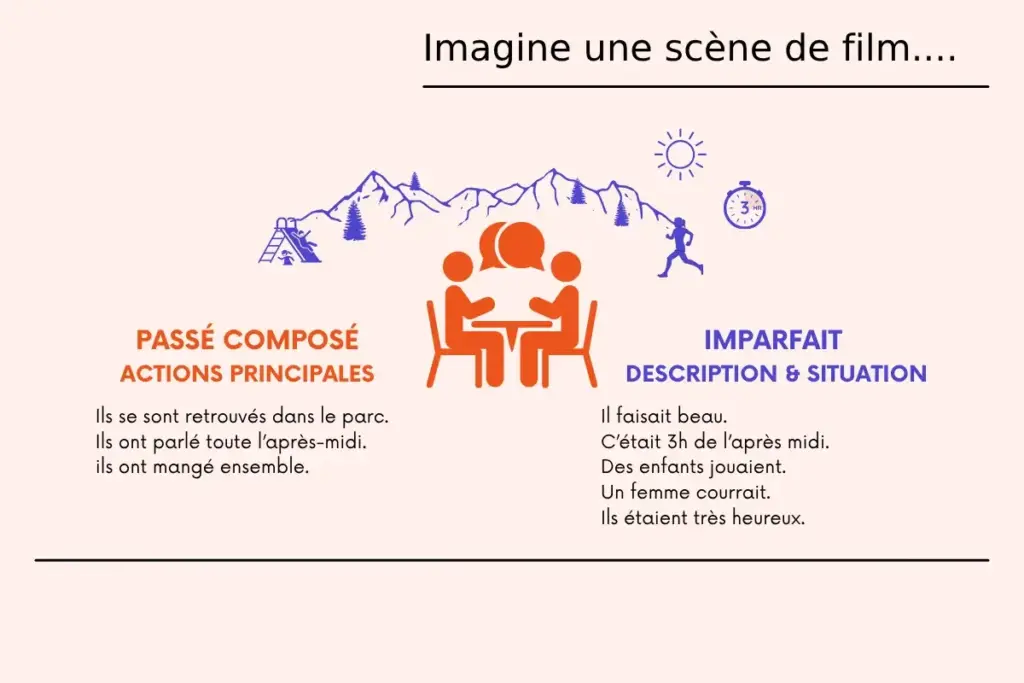
Imparfait for setting the scene, passé composé for the action
The imperfect tense is used to describe the background : the setting, the climate, the emotions.
Il faisait chaud, la mer était calme, les enfants jouaient sur la plage.
The passé composé, on the other hand, tells the main actions, those that move your story forward.
Il est arrivé, il l’a vue et ils ont commencé à parler.
The first creates the framework, the second gives movement: that's their complementarity.
What to do when one action interrupts another?
Sometimes, two actions intersect in the past: one was happening, and the other interrupted it.
In this case, we use the imparfait for an ongoing action and the passé composé for sudden actions.
Je regardais la télé quand le téléphone a sonné.
The imparfait(je regardais)sets the scene, the passé composé(a sonné)marks the cutoff.
This contrast makes your story clearer: we understand what was happening and what came to change the situation.
This is the secret to telling natural and lively stories.
The most common errors when choosing between the passé composé and the imparfait
Even with a good understanding of the rules, certain mistakes recur frequently. These small details, however, make all the difference between “schoolbook” French and fluid, natural French.
Use the right tense for emotions
It is often thought that emotions always use the imperfect tense, but it all depends on the meaning.
Ask yourself the question: What is the main action of my story?
The passé composé emphasizes what you really want to tell, your focus.
If emotion is a detail of the context → imperfect.
J’étais triste parce qu’il pleuvait.
If it is the heart of your story, so a main action → passé composé.
J’ai été surprise quand il m’a annoncé la nouvelle.
It's up to you to decide what you want to show: your emotion can be simple background... or the central event.
Confusing the pronunciation between “é” and “ais”
Another common mistake: the pronunciation.
- J’ai parlé (passé composé) → son [é], more closed and shorter → like a smile
- Je parlais (imparfait) → son [è], more open and longer.
Paying attention to this difference helps you to be better understood and to recognize moods when you listen to French.
You now know how to distinguish between the passé composé and the imparfait.
You can spot the main actions, describe the setting, and tell a story in the past tense like a true French speaker.
Keep practicing a little bit every day; that's the secret to making these two moods feel natural.
If you want to go further and learn to speak more spontaneously, check out my free video:
How to think in French and stop translating in your head.
It will help you gain confidence in public speaking.